Your First Meeting in 7 Days. 24 Meetings in 6 Months.

.png)
TL;DR
- Median time to first meeting booked: 7 days. 46% book in week one, 72% within two weeks.
- The first meeting is a proof point, not the destination. Output compounds every month through month 4.
- Customers completing a full 6-month engagement average 24 meetings, nearly 8x what they book in month one.
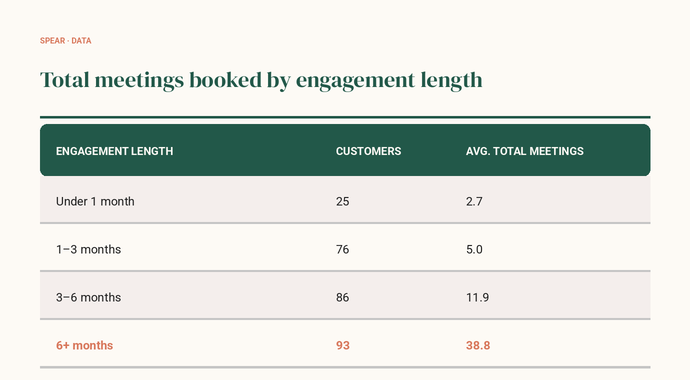
- Customers active 6+ months average 38.8 total meetings vs. 2.7 for those who stop within a month.
Why outbound is usually evaluated wrong
Most outbound evaluations fail in one of two ways: results are expected too fast, or the engagement is cut before the compounding starts. Month one is a calibration period. The system is learning which signals fire for your ICP, which message angles land, which segments move first. Judging the tool at 30 days is like judging a new sales hire after their first two weeks.
According to Expandi's State of LinkedIn Outreach in 2025, B2B customer journeys regularly stretch over 6 months from first touch to a won deal, with buying committees averaging 6.3 stakeholders. Outbound that works against that reality cannot be meaningfully evaluated in a few weeks.
The first meeting tells you the targeting is right. The next 23 tell you the system is working.
Week one: the early proof point
Across 279 Spear customer journeys, we measured the time from the first approved prospect to the first meeting booked. Nearly half book in week one. Three in four book within two weeks.
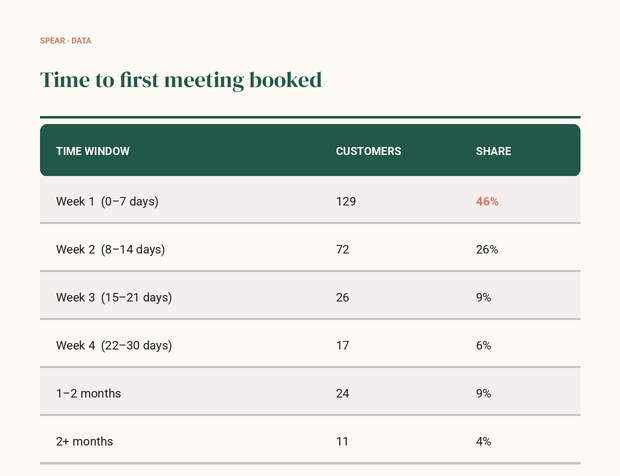
The distribution is front-loaded because Spear surfaces prospects at the moment a relevant signal fires: a new hire, a funding round, a technology change. Timely messages book faster. The 25th percentile sits at 4 days, the 75th at 15 days. For most customers, the question of whether outreach works is answered within two weeks. What that window cannot answer is how much the output grows.
Months 1 through 6: where the real story is
We tracked 86 customers through a full 6-month engagement. Monthly meetings per customer rise consistently from month 1 through month 4, then hold steady. This is the system learning: early months identify which signals convert for your ICP, which segments move fastest, and which message angles get replies. By month 3, outreach is concentrated on a higher-confidence subset of prospects.
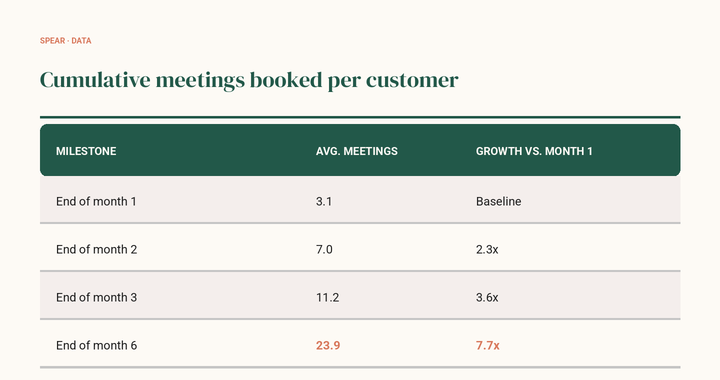
A customer who evaluates Spear after month 1 sees 3.1 meetings. A customer who completes the full 6-month POV sees 23.9. The difference is not the tool, it is the time horizon.
The engagement-length comparison makes this even clearer. Customers who stay 6 or more months book nearly 15 times the meetings of those who stop within a month.
Salesmotion's 2026 analysis of LinkedIn outreach reinforces why: signal-driven outreach achieves 15–25% response rates vs. 1–2% for generic templates. The compounding Spear customers see over 6 months comes from outreach that gets more signal-precise every month, not less.
Stopping outreach after 30 days because you only have 3 meetings is like judging a compound interest account after one month's interest payment.
What each month of a 6-month POV actually delivers
- Month 1 – calibration. ICP targeting is defined, signals are selected, first outreach goes out. Average output: 3–5 meetings. The first booking, typically within the first week, confirms the system is live.
- Month 2 – iteration. Response data feeds back in. Signals that fired but did not convert get deprioritized. Message angles that generated replies get refined. Average output: 5–6 meetings.
- Month 3 – acceleration. The system prioritizes with confidence. Average output: 5.3–5.8 meetings. Most customers first see pipeline that feels predictable rather than opportunistic.
- Months 4 through 6 – compounding. Output holds at 4.5–5.8 meetings per month. Cumulative total reaches approximately 24. Customers entering a renewal conversation have data, not a promise.
Frequently asked questions
How long does it take to see ROI from outbound sales?
With Spear, the first proof point arrives fast: median first meeting in 7 days. Meaningful pipeline emerges over 3–6 months as the system learns and the output compounds. Days to your first meeting, months to a full pipeline.
What is a proof of value (POV) in B2B outbound?
A structured engagement, typically 3–6 months, designed to demonstrate measurable results before full contract commitment. A 6-month POV covers calibration (month 1), learning (months 2–3), and compounding (months 4–6). Evaluating outbound at 30 days means measuring the calibration period, not the outcome.
How many meetings should I expect from a 6-month outbound POV?
Based on Spear customer data across 86 customers completing a full 6-month engagement: 23.9 meetings on average. Month 1 alone averages 3.1.
Is LinkedIn outreach still effective in 2026?
Yes. LinkedIn's late-2025 InMail caps made volume-based outreach harder, but signal-driven outreach, timed to real buying triggers, continues to perform well. The constraint forces relevance, which is exactly what drives Spear's compounding effect.
Methodology. 279 Spear customer profiles with at least one approved prospect and one meeting booked. Start point: first approved prospect timestamp. End point: first meeting booked timestamp. Monthly analysis: 86 profiles with activity across at least 5 of the first 6 months. Engagement cohorts: all profiles grouped by time between first approval and last recorded meeting. Median reported for time-to-first-meeting (right-skewed distribution). Mean reported for cumulative and monthly counts. The 6-month cohort skews toward more engaged customers; the 38.8-meeting average reflects customers who completed the full engagement, not a universal projection.
.png)
.png)