Which Outbound Triggers Convert Best? 177,629 LinkedIn Requests, Ranked


By Spear Labs, Spear's research team · Updated October 12, 2026 · Data from 90+ B2B sales teams running trigger-based outbound
Quick answer: Podcast and interview appearances are the best-converting trigger in trigger-based outbound. Spear Labs compared 9 trigger categories, covering more than 40 individual triggers, across 177,629 LinkedIn requests. Podcast guests accepted 46% of connection requests and produced 4.6x the positive replies of company news. LinkedIn activity, events, awards and job changes follow. How long a trigger lasts depends on the moment: LinkedIn posts fade within weeks, while podcast appearances and company news hold.
Key takeaways
- We compared 9 trigger categories, from podcast appearances to funding rounds. Each category groups several individual triggers.
- Personal triggers (what a person said, did or achieved) produce roughly 2x to 5x the positive replies of company triggers (what their company announced).
- The best triggers are the rarest. Podcasts and interviews are under 1% of trigger volume. Company news is 30% of volume and among the weakest.
- Shelf life depends on the moment. Acceptance on LinkedIn activity falls from 44% to 31% over two months. Company news stays at about 20%, and podcast appearances hold for weeks.
- A 60-day-old LinkedIn post still outperforms fresh company news.
Methodology. Source: anonymized Spear platform data, with internal and test accounts excluded. Ranking: 177,629 trigger-based LinkedIn connection requests sent October 1, 2025 to August 31, 2026, each counted under its primary trigger and grouped into 9 trigger categories. Timing analysis: the 76,986 of those requests with a recorded trigger date. We report acceptance and reply rates, and each category's positive-reply rate relative to company news, the most common trigger. A positive reply means the prospect reached "Interested" or "Meeting Booked." Categories with fewer than 1,000 requests are left out. Observational data: read gaps as strong signals, not controlled experiments. Data pulled October 11, 2026.
What is trigger-based outbound?
Trigger-based outbound means reaching out because something real just happened, and opening the conversation with it instead of a cold pitch. The trigger is that moment: a prospect's podcast episode, a post, a talk, a new role, or a launch at their company.
Triggers come in two kinds. Personal triggers give you a reason to connect with the person. Company triggers tell you something changed where they work. Trigger age is the time between the trigger and your outreach.
A trigger is not the same as a buying signal. A buying signal suggests someone is in market, like a visit to your pricing page. Most of the best triggers in this study show no buying intent at all. They work because they make the conversation about the person, not the product.
Spear surfaces triggers daily through its trigger library, and executives and AEs approve each prospect before outreach goes out. Because both moments are timestamped, we can measure what each trigger is worth and how long it lasts. Here's how the workflow runs.
Finding 01: Which outbound triggers convert best?
We grouped Spear's triggers into 9 categories. Each one covers several individual triggers: LinkedIn activity, for example, includes posts, comments, reposts and LinkedIn events.
Spear Labs data shows podcast and interview appearances are the best-converting outbound trigger on LinkedIn: 46% connection acceptance, an 18% reply rate, and 4.6x the positive replies of company news. The top five categories are all personal triggers. The bottom four are all company triggers.
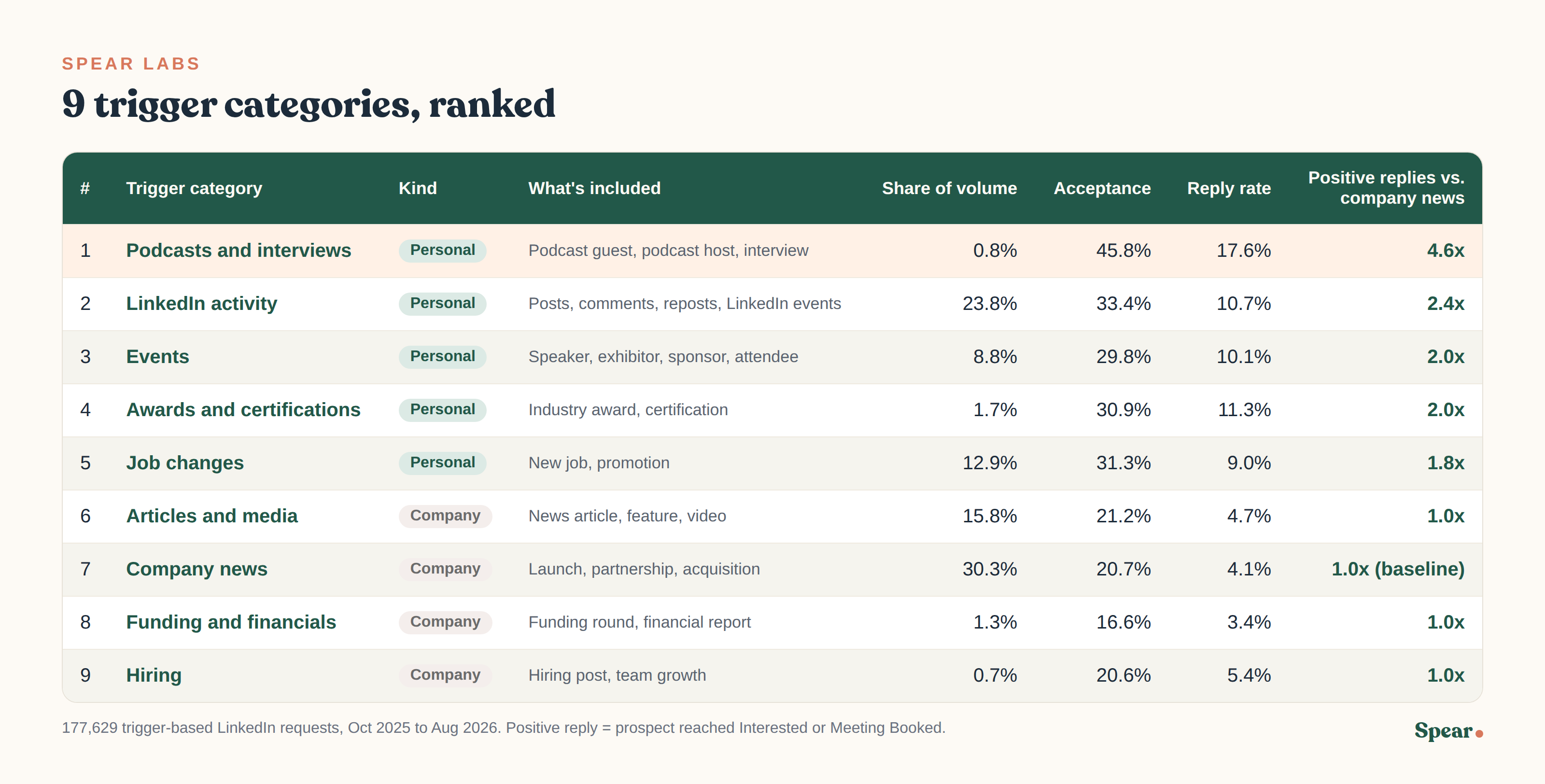
Positive replies vs. company news: each category's positive-reply rate divided by the rate for company news. Smallest category included: 1,231 requests (hiring); podcasts and interviews: 1,392 requests from 69 teams.
Why the gap? A personal trigger gives you something to say to that specific person: their episode, their talk, their post. A company trigger gives you something to say to anyone who works there, and prospects can tell.
Finding 02: The best triggers are the rarest
Volume and quality run in opposite directions. Company news makes up 30% of all trigger volume and gets 21% acceptance. Podcasts and interviews make up less than 1% and get 46%.
Spear Labs data shows that the four highest-converting trigger categories together account for only 35% of trigger volume.
The practical risk: if your queue is ordered by whatever arrives, the weakest triggers crowd out the strongest. Rare triggers need to be hunted deliberately, not waited for.
Finding 03: How long does a trigger last?
It depends on the moment. Spear Labs data shows acceptance on LinkedIn activity triggers falls from 44% within 7 days to 31% after 60 days, and replies fall from 17% to 9%. Positive replies drop by more than half after 30 days. Company news holds at about 20% acceptance the whole time.
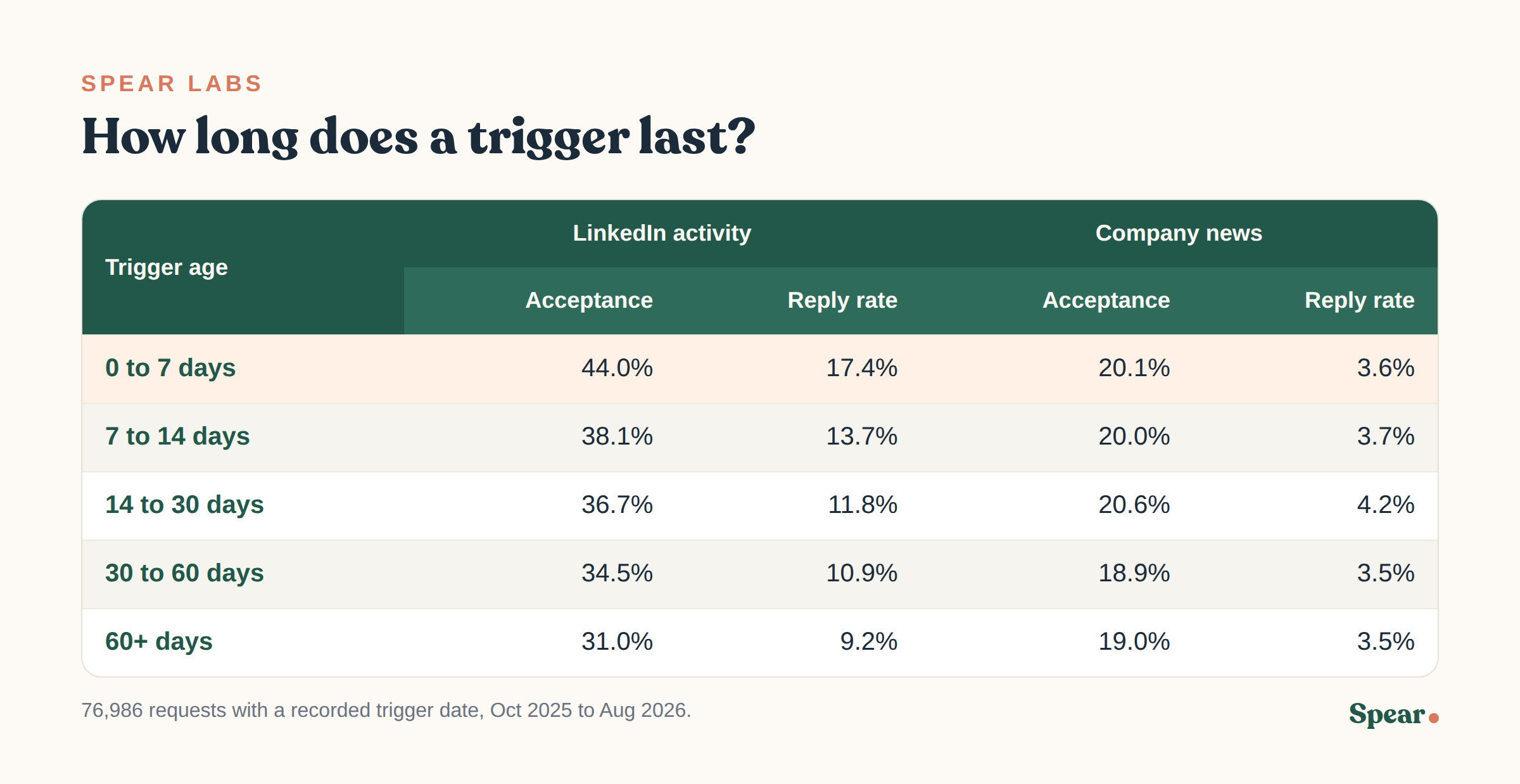
Sample: 17,069 LinkedIn activity requests (1,521 to 4,987 per window) and 32,519 company news requests (1,783 to 10,078 per window).
Podcast appearances hold up too. Acceptance stays at around 50% through the first month after an episode. That's based on about 800 requests, so treat it as directional.
The difference is how much the moment meant to the person. A post is casual: written between meetings, forgotten by next week. A podcast took preparation, and guests keep sharing the episode for weeks. Company news stays true for months, but it was never personal to begin with.
This matches how LinkedIn itself works. Metricool's 2026 LinkedIn study of 673,658 posts found half of a post's impressions arrive in its first 48 hours, and on personal profiles close to 40% of interactions happen on day one. Harvard Business Review's research on the short life of online sales leads found the same pattern for inbound interest: it decays fast after it first appears.
Finding 04: A 60-day-old LinkedIn post beats fresh company news
Even after 60 days, LinkedIn activity triggers get 31% acceptance and a 9% reply rate. Company news in its first week gets 20% and 4%. In positive replies, the 60-day-old post still comes out 2.5x ahead.
Trigger type matters more than trigger age. Fresh personal triggers beat everything.
How should you prioritize your triggers?
Rank by trigger type first, then by how fast it fades:
- Work personal triggers first. Podcasts and interviews, LinkedIn activity, events, awards and job changes.
- Give LinkedIn activity a 7-day deadline. Posts and comments fade fastest. Review that lane every two or three days.
- Take your time on podcasts and talks. They hold for weeks, so it's worth listening to the episode and writing something specific.
- Hunt rare triggers on purpose. Podcast guests and event speakers won't fill a queue by themselves. Track them as dedicated sources so they don't get buried under company news.
- Use company triggers to fill gaps, not to set priorities. They hold their value for months and can wait their turn.
Not sure which kind a trigger is? The Spear triggers guide breaks down every type. For the broader argument, read The Case for Trigger-Based Outbound: How Timing Beats Targeting.
Frequently asked questions
What is trigger-based outbound?
Outreach that opens with something real that just happened to the prospect or their company, like a podcast appearance, a post, a new role or a product launch, instead of a cold pitch.
Which triggers work best for outbound?
Personal triggers. Spear Labs compared 9 trigger categories across 177,629 LinkedIn requests. Podcast and interview appearances ranked first, with 46% acceptance and 4.6x the positive replies of company news, followed by LinkedIn activity, events, awards and job changes.
Is a LinkedIn post a buying signal?
No. A LinkedIn post is a personal trigger: a reason to start a relevant conversation, not evidence of buying intent. In Spear Labs data, personal triggers produce roughly 2x to 5x the positive replies of company triggers.
Are podcasts a good trigger?
Yes, the best in Spear Labs data: 46% acceptance and an 18% reply rate, though they make up under 1% of trigger volume. They also hold their value for weeks after the episode.
Are job changes a good trigger?
Yes. Job changes get 31% acceptance and 1.8x the positive replies of company news, and they make up 13% of trigger volume.
How quickly should you reach out after a trigger?
It depends on the trigger. Act on LinkedIn posts and comments within 7 days: acceptance falls from 44% to 31% over two months. Podcast appearances and company news hold their value for weeks.
Do triggers expire?
Some do. LinkedIn activity fades within weeks. Podcast appearances and company news hold, though company news starts much weaker.
What is a good acceptance rate for trigger-based LinkedIn outreach?
It depends on the trigger: 46% for podcasts and interviews, 44% for LinkedIn activity from the past week, and about 20% for company news.
About Spear Labs
Spear Labs is Spear's research team. It publishes findings from anonymized Spear platform data on what makes trigger-based outbound work. To cite this study: Spear Labs, "Which Outbound Triggers Convert Best? 177,629 LinkedIn Requests, Ranked," October 2026, getspear.ai.
Want the strongest triggers for your ICP, surfaced every day? Try Spear free for 2 weeks.